Sunday, 31 July 2016

Galaxy Building Star Control 2

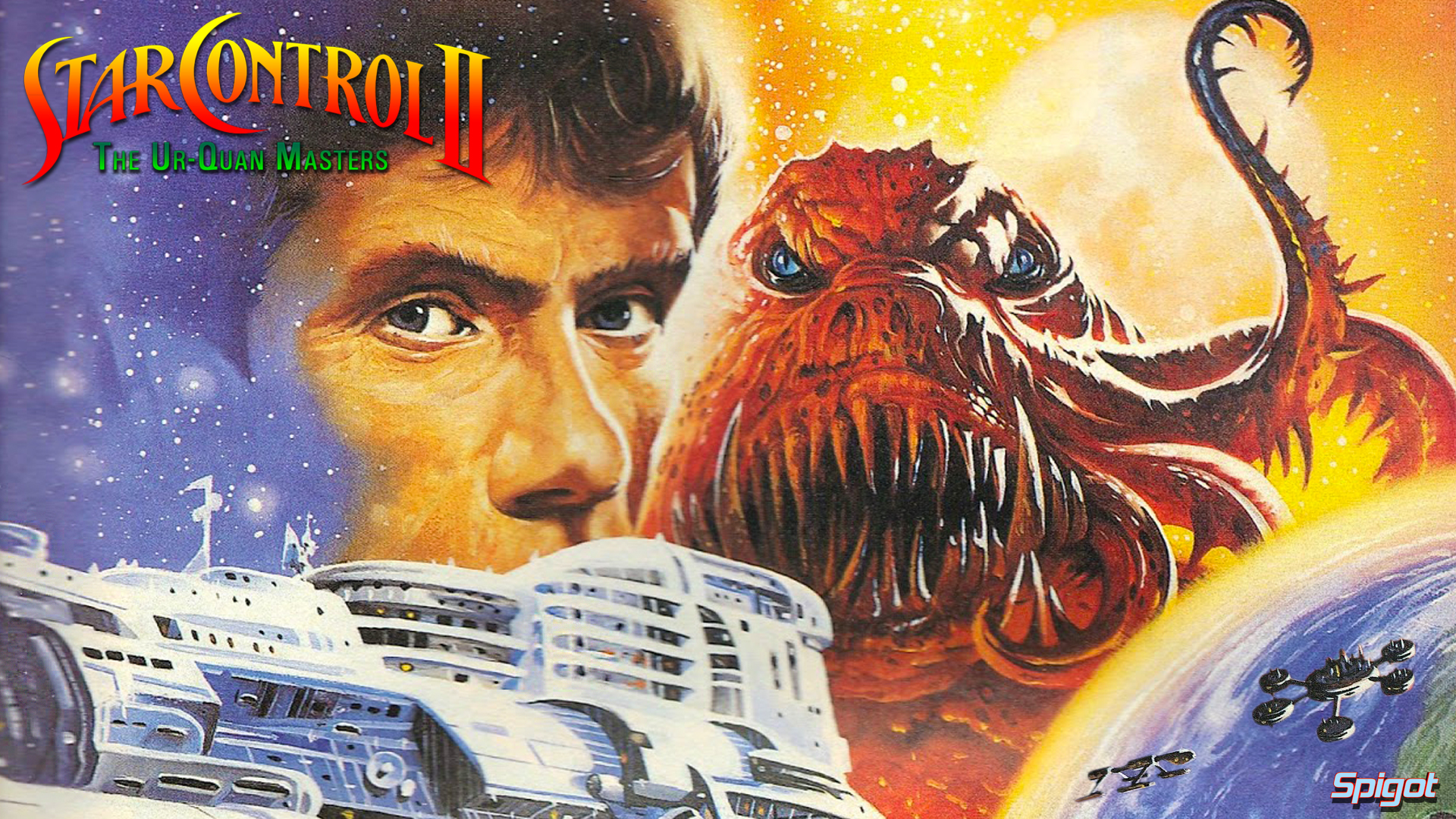
That red monster in the back is a nice conqueror 
The worldbuilding taking place in Star Control 2 is a monumental achievement for a game of its era. The introduction lays the ground work for the game and sets the player up as the saviour of the galaxy. This isn't a game about worldbuilding its a game about galaxy building as the share size of the galaxy is enormous. The start of the game and how to goes about explaining the origin reminded me of games such as the halo and mass effect series. Even going as far as to have a race who's technology was far greater than anyone else's after them. Upon playing the game I found that the dire situation to which the player is placed in does a fine job of giving the player motivation to continue playing it also establishes the world that the player is going into. The many worlds that inhabit the solar system in the game are similar in the way that the player interacts with them however it does enough to make the player feel like each planet is different and unique. Along with these unique planets are the alien races that inhabit them, so far I've only managed to contact maybe half the alien races that I believe to be included in the game. An interaction with each alien race is distinctive and does not feel formulaic, 

The casualties of war
I found the alien race Zoq Fot Pik humurous with their multi-cultural society. The games months carry on and if you miss certain information you miss chances to be able to either save another race or recruit another race into your cause. I found this out the hard way as I did not heed the call for help from Zoq Fot Pik and their entire race were wiped out by the enemy. I felt sad about what happened but also thought that it was a brilliant piece of worldbuilding taking place, a world that does not wait for the player much similar to how real world time operates. It's this familiarity with the concept of time that makes this world much more believable. In this instance I also felt that the best worldbuilders build worlds that people want to actively participate in. When you take a look at books or other video games with well built worlds people dedicate hours and years to thoroughly explore these worlds over and over again, think Skyrim, Lord of the rings or even Destiny. This was more evident to me when I found myself still playing Star Control 2 well into the 18 hour mark, and the more time I invested in this world the more I wanted to see my quest to save the galaxy through to the end.

Friday, 29 July 2016

This is Not a Promise To Share My thoughts on The Stanley Parable Demo

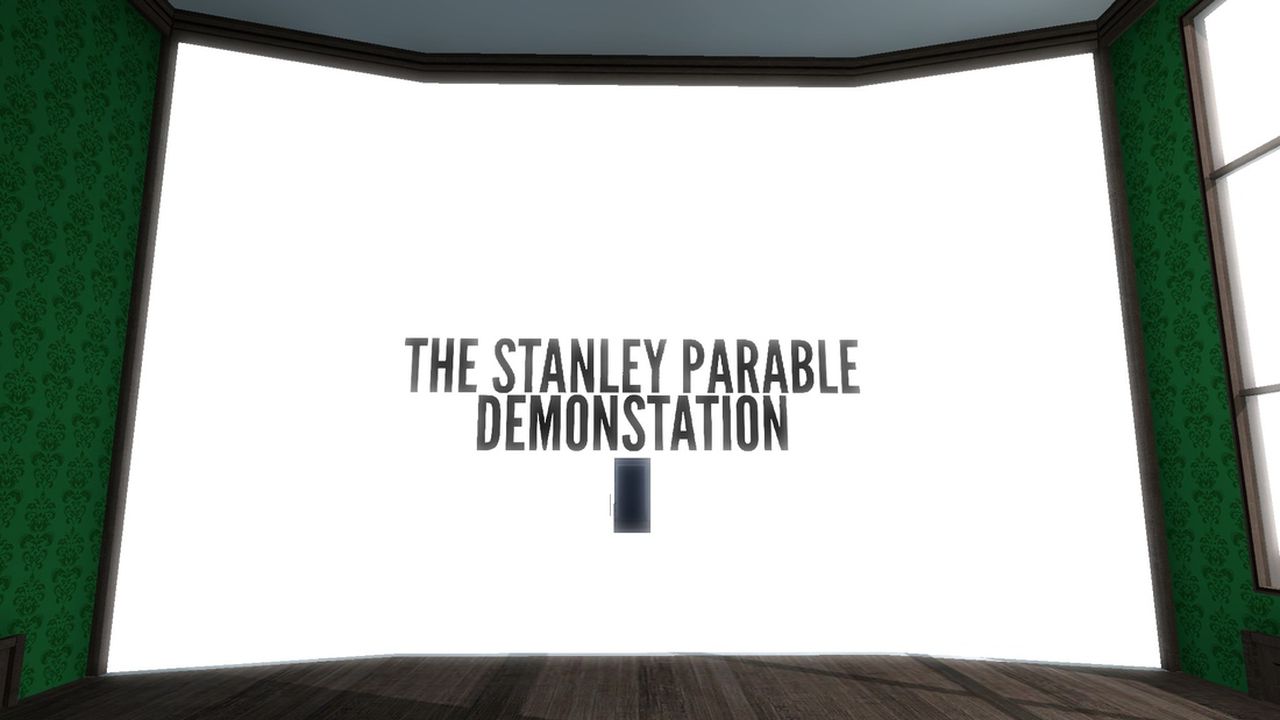
You're almost about to play the demo

The demo that was not a demo but rather a gathering of thoughts that seemed coherent but weren't really coherent but placed in a way to make sense of nothing much at all to begin with. This to me sums up how I felt about playing the Stanley Parable demo. Can this even be called a demo? can it even be called a game to begin with? What is a game? These are the kinds of questions that I ask myself after playing this game. Its breaking of the fourth wall is an experience that puts the player right into the front seat. The game is very aware of the player and it's this awareness that carries this experience, if this is a precursor to the actual game it would do the game justice of encourages players to purchase the retail version to see where the game wants to take you or accuse you of next. 

I did not press this button for 10 minutes
The way the game speaks to the player it feels alive and yet very responsive to what the player is doing on screen, through all the dialogue it never felt to repetitive to the point where the narrator became annoying or overbearing he had the right mix of witty banter mixed in with direction to control the pacing of the game. It starts with the promise of a demo, and continually promises the player of this grandiose demo that's only just around the corner. It's a demo that's built upon the hype factor and trying to encourage the player to do strange things. Due to the way the game is setup I felt the need to constantly rebel against what the narrator was asking me to do, one of the first instances that this happens is the first time you walk into the screen room and it asks you to stay as still as possible for 20 minutes. I moved straight away and it triggered the next event. Another moment in the demo I felt carried weight was the first moment the player is presented with the yes or no answer for if they would purchase the full game, as the player approaches the platform his movement speed is slowed, its gives the player the feeling of physical weight to whether or not they would purchase it. It also likes to mention a lot that the decision to purchase the game should not be taken lately and should be an exciting prospect for the player. The game purposely tries to use reverse psychology on the player to be able to achieve a intriguing level of engagement. There are many scientific case studies where children are given a choice of eating the marshmallow now or wait for another 20 minutes and they would receive another marshmallow, it's the promise of more that some children will wait where others will not. This to me is exactly what the Stanley parable demo is. It is exactly as to what a demo should always be for any video game the promise of more.

Image References

https://cdn2.vox-cdn.com/thumbor/6d2eY16-GURgHTFl2ZgZkDz0Tt8=/0x72:1100x691/1280x720/cdn0.vox-cdn.com/uploads/chorus_image/image/20945843/2013-10-09_00005.0.jpg

https://i.ytimg.com/vi/eIELkO7zSZw/maxresdefault.jpg

Sunday, 19 June 2016

Last Moment Changes - Game Studies Week 7

Game Changer

Upon reflecting upon the feedback I received from Tece, I had remembered that she challenged the idea of me looking specifically at Uncharted 3 and The last of Us. Citing that all I would be saying is that Naughty Dog knows how to make their games different, although this is not how I actually approached this, as I was looking more at what was similar and how similar trends cross over between genres It made sense as well to change it. So as a last minute decision I changed Uncharted 3 out for a game in the same genre. I am now going to discuss the game I Am Alive by Ubisoft Shanghai. Not only are they in the same genre but they also share a similar beginning where both games are set in a future after an event that has crashed the society around us as we know it. Being both survival horror games as Tece noted I could talk about what they do right and what they do wrong being from the same genre. That's not say I wont use Uncharted 3 s an example its just that it would be a more minor role in my final artefact. I also wanted to look at how well both games did in comparison to each other and if colour could have played a role in this. And if so this would then give more backing to why colour is important in video games. Which is the heart and soul of my artefact. Playing I Am Alive, the first thing I thought was that the colours are far to washed out. I know it was meant to be this way from the games perspective, but it was not something that added to the experience rather it took away from what the game could have been. Everything is grey, or white, or near to grey. The way the game guides the player around was strange as well, rather than it be subtle the game would have a bright white light to show the player this was where you had to go. At the same time it would get caught up with the shinning light of the same. It just did not make much sense at all. If we were to contrast this to the Last of Us by Naughty Dog you can clearly see everything. In the Last of Us you still get that feeling of a survival horror but their use of colour is not as washed out or in colour theory terms lacking saturation. If anything the Last of Us is in complete opposite to that I Am Alive. Which for me helps make a great case as to why colour is important in video games. Even though the game is colourful you still experience that it is not the world that we are used to and that feeling of dread is still ever present within the game. This was an important factor to place into my artefact, it may be rushed but at the same time it would not convey the same thoughts that using Uncharted 3 as a contract would have, I hope by doing this that I can provide better proof for why colour is important.

Resulting Colour Interpretation - Games Studies Week 6

Results Give Confidence.

Last week I spoke to Tece about the current state of my work, she read the new introduction and found that it went into detail far too early and that I should try to avoid repeating myself in the lines afterwards. Upon re-reading my work I could see why she would say this as I currently have a bad habit of repeating what I’ve said before all most too similarly. It’s a apart of my writing and is something I know am trying to proactivly counter in my writing. She to also pointed some out as an example so to give me a better understanding of my writing. Another fault found in my work was that I used a lot of first person statements. It came off sounding more like the proposal rather than the body of work that I was trying to create. However what I found was helpful was talking about where this research assignment could go and the format that it could be put in. This was great as I have been having issues with finding a way to link them all in. She particularly liked how I formated in why is it important and how it is important. She also spoke about how adding my why into the intro was a great way for people to see how the information that will be conveyed in this research assignment could be handy. After this I went away and reworded my introduction and also decided to leave it alone for now and focus on other parts of the essay. Some interesting information I found was that of Angela Wright who wrote about how colour affects people in “The colour affects system”. She goes on to talk about how it’s not just one colour that affects a person, it is a combination of the right hues. Her work has been proven scientifically and has helped to show that colour can be objective. A study done in 2002 by Li Chen Qu looked into whether or not we were affected by colour and if our cultural surroundings played any effect on this. The study included participants from europe and china, with startling results suggesting that regardless of ethnicity or gender colour can affect us in the same way. In her research she concludes that there are 4 different groups of people, and that people from 1 of those groups will all react the same way to colour as everyone else in the group. So in saying that everyone from group 1 will react the same, and that everyone from group 2 would react the same and so on and so forth. What they would react to would be a specific set of colours that would be classed for that specific group. This information combined with my look at colour physiology would be exactly what I needed to give my essay more substance in the way of factual results. Wright’s view on colour theory was that Newton and Goethe weren’t wrong and that a hybrid of their work would be similar to those views that Aristotle held earlier and that their views were an extension on to what had come before. Wright’s research was more to do with marketing, as she spoke about how important it is for a business to understand what colours they are using and how these colours can affect their potential customers. Previous research shows that red has the abilities to activate the viewer’s memory better but due to its negative association with aggressive tendencies might not be the best choice depending on what it is you are selling. Crowley noted in a paper in 1993 that red was best suited for impulse buying due to its ability to activate high arousal. It was in reading these that I found that marketing has a wealth of information regarding colour and here that I would find the basis for the majority of my claims, this in conjunction with colour psychology and colour physiology would be the backbone to my artefact.

Stand up Presentation - Game Studies Week 5

Feedback on my Presentation

This week we did our presentation to the class to discuss our subject matter and our findings. With my presentation and presenting what I had found I had got given some good feedback. One of the worrying things about my essay was that a lot of the info I had presented I had not presented with any actually quotes to back up what I had said. For example I applied one of the tests to the class to try it out and see if it works. The test was just getting them to stare at black and then at red, and asked what kind of feelings or how did those colours make them feel. It worked well because in some of the students observing they felt the way that my research had informed me they would but the problem was without any scientific or examples this part of the presentation came off as a “The colour does this” kind of notion, without the information it lacked any real traction and came off wrong. Which brings me to another point the presentation itself did not have much of the info relayed properly and another big problem was trying to find a way to be able to link the scientific branch of the colour psychology into colour theory correctly. As Jordan felt talking about the science of Optiks was one of the parts that didn't quite fit in with the rest of the info I was relaying and wondered whether it might be better for my artefact to drop this portion all together. He felt that I should just look at it briefly and rather focus more on how it helped our understanding of colour rather than going into the scientific talk surrounding it. Well I do agree with him I felt that if I did not give a bit more light to it that it would lose the impact of what I wanted to talk about using Goethe as a counter argument to it. But through this thinking I did find that I was focusing far too much on this basic and neglecting the actual question that I wanted to pursue and answer. As highlighted in my previous blog post, one of the students talked about trying to find a way to convey that use of colour was done intentionally rather than saying “We did this just because”. Which is exactly the issue that I have with this topic. I didn’t display my findings on the use of colour physiology just yet as I had not researched into this enough to give sound reason behind its use. Reflecting further on the presentation this could have given me more confidence as well as those listening to me, a better understanding for the topic. From what I’ve found on this subject is that colour has an effect on the body physically, colours like red as an example cause what’s called high arousal, this is measured in elevated heart rate, blood pressure and activates an alertness in the viewer. The reason for this could possibly be linked to how man has survived for so long, and is really a great evolutionary tool that has given our species what it needed to thrive. As colour was a way of understanding what would be good to eat, what to avoid and how to track something. As said before colour physiology doesn't adhere to being subjective as much as psychology which in that case would help present my case regarding my topic.

Saturday, 18 June 2016

Colour my Games - Game Studies Week 4

Colour My Games.

Building on my thoughts from the previous weeks blog, I decided to look at the use of colour with Uncharted 3 and The last of us, both games are my by Naughty Dog. I wanted to look at how both games share similar uses of colour but at the same time have found ways to differentiate from each other. I thought this would be a good way of being able to take two games from different genre’s and compare how they are coloured in a way to suite their respective genre’s. This lead me to looking at colour techniques that are used within video games, for instance the use of colour grading which was a technique borrowed from film to be able to suggest to the player different times and locations. Or to try and imply a different tone. Another interesting use of colour within video games was colour cycling which was a form of animation for video games in the early 90’s, it allowed for the ability to shift colours around on screen to give the player the illusion of animation when in actuality the programmer placed a code to change the pixel colour to give it movement. This was mainly used for the elements like water, fire etc. Colour Cycling died out eventually and would be due to the advancement in technology. As it was used as a way to save memory for more important things that would happen in game, when you think about events such as the release of the original PlayStation, which arrived as the first console in history to be able to support up to 16.7 million different colours on screen where prior to this the highest number was 4096 from the NeoGeo in 1990 of a possible 65536. The PlayStation was a monumental jump for console gaming and since then has not looked back. Upon further research for my artefact, I did not find much in the way of colour psychology, as a lot of the information was countered by other research that was done. The main issues I found was that because of colours highly subjective nature, being influenced by our surroundings, upbringing or culture it made it difficult to back up any claims that I could make. It was at this notion that I found colour physiology as a way to help provide proof. As colour physiology was less reliant on an answer from the participant reviewing the use of said colours. This was a breakthrough As I felt I was not getting much traction in regards to my artefact.

The deeds and sufferings - Game Studies Week 3

"Colours are the deeds and sufferings of light" - Johann Wolfgang Van Goethe

This week I began writing the body of the essay talking about Newton’s theory of colour and how it gave birth to the science of Optiks. It was interesting as noted in my first blog post about how colour is a product of light. The experiment conducted by Newton involved blocking out all light from a room, and only allowing light to come through a hole, controlling how it enters into the area. Once this is done Newton placed a glass prism in front of the light and saw how doing this produced the colours of the rainbow through the refraction of all the light. It was here that he concluded that light is what makes colours. He refused Aristotle's theory that light was was a combination of light and dark. With his experiment he felt that he was able to prove his theory correct. For the most of part of the next century his colour theory would be held to as scientific fact as through science he was able to prove it. In the next 100 years a man by the name of Johann Wolfgang Van Goethe, a German poet who countered Newton’s theory. He conducted the same experiment but in reverse and found that you could still get some colour out of using the darkness as well. Which in turn was return to the similar thinking that Aristotle held prior to that of Newtons. However at the time Goethe’s contemporaries at the time never took him seriously enough as there was not enough science behind his methods. As a poet and an artist who also believed that the colour phenomena could not just be looked at through science and that the viewer would have to also use their own intuition when perceiving colour. As he saw it in his book the theory of colour, he believed that because we are apart of nature man cannot remove himself from nature to observe her and this was in case and point to counter how Newton removed man from the equation when he used the prism to observe light. Both of these men have contributed greatly to colour theory and both as well have contributed to the evolution of the colour wheel theory. With this in mind I pondered how would I be able to get enough information or show my perception correctly on the topic of colour. One avenue I thought would be really handy would be to look at how colour is perceived in the way it is used in film. Thinking about films I thought the following films fit perfectly into what could help me with my essay, I was looking at films like Equilibrium, The matrix and pleasantville. Equilibrium for instance we can look at how monotone and desaturated all colours are in the film, this could be to try and mute emotions within humans as it is believed that emotion is the true reason for wars which is the basic plotline to the movie. The Matrix on the other hand has the dull green tinged world that is within the matrix and how the people who know it is a dream are presented in the world with cold colours, this is also represented in the contract between the matrix world and real world where the matrix has a green tint and the real world has a blue tint. The last film on the list Pleasantville, starts out completely desaturated and all the viewer is able to see is black and white tones. As the movie goes on some things within the movie become coloured which the people in the movie begin to fear what they do not know. I thought these movies showed great use of colour in film and in all these cases have a specific use for them which in case could help me formulate why colour would be important in video games. In noting this after a discussion with Tece I've found that I have no video games to be able to relate these concepts to and in turn will need to as as soon as possible.